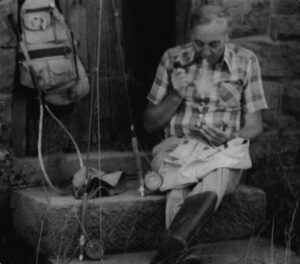
Tom Sutcliffe wrote:
Born HB Huntley in Pietermaritzburg KZN in the mid-1930s, Hugh Huntley’s nickname was Hooks and Bullets, which says a lot about the direction his life took. I first got to know him back in 1970, after which we ended up regularly fishing and hunting together for the next 25 years. He died in May 2006. Adjectives don’t do this man’s outdoor skills any real justice. He was the best wing shot I ever knew, a wonderfully steady and measured fly fisher and, in his prime, he was undoubtedly the best fly tyer this country had. He tied with enviable speed, discipline and mastery. In judging any other fly tyer’s skills he was always clear. He believed anyone could tie a decent Gold Ribbed Hare’s Ear, but tying a perfectly winged Connemara Black as Hugh used to put it, “… sorts the men from the children”. And I guess he was right, at least when it came to demonstrating any real mastery of fingers over feathers. Hugh developed the Red-eyed Damsel and the Orangeade, but the truth is he tied many other useful patterns that, for one or other reason, didn’t stand the test of time– not to mention a few that may have been way ahead of their time.
Hugh Huntley (died May 2006) was a legendary Pietermaritzburg-based South African fly fisherman, known as “Hooks and Bullets”. A masterful fly tyer and crack shot, he famously invented the Red-eyed Damsel nymph. He was a pioneer in Natal fly fishing and a highly respected figure among anglers.
Key Highlights:
- Legacy: Huntley was renowned for his skill in tying, especially the Red-eyed Damsel, which originated when he ran out of black chenille and used red instead.
- Fishing Prowess: Described as a wonderfully steady fly fisher and arguably the best fly tyer in South Africa in his prime, he was also an expert wing shot. Hugh had an uncanny way of knowing when the fish would bite. If he stayed in his bakkie at the waterside to listen to the rugby on the radio, his companions knew that there would be little sense in fishing. He was that good.
- Contribution: He was involved with the early development of fly fishing in Pietermaritzburg. He was a founding partner of South Africa’s first fly-fishing shop “The Flyfisherman” in Pietermaritzburg (founded 1981)
- Profile: He was a regular in local fishing circles and a friend of many renowned anglers, such as Tom Sutcliffe.
He passed away in May 2006.
Notes by Andrew Fowler
I got to know Hugh pretty much from the time I started high school. That was through visits to the newly opened “Flyfisherman” in Harwin’s Arcade in Maritzburg, and then also when the Natal Fly Fisher’s Club (NFFC) started a series of fly tying lessons at the Imperial Hotel, put on by Hugh and others. On leaving school (1985) I started attending the Natal Fly Dresser’s Society meetings at Chamber House at the Royal Show grounds in Maritzburg, where Hugh was a regular and gave many a demonstration, which I remember well. Hugh was quiet spoken, and usually engaged in a long pause before answering a question, or entering a conversation. Him and Tom Sutcliffe were very close. Tom called him “Kehla” (“old man” in isiZulu). Of course we saw a lot of Hugh at The Flyfisherman shop which later moved to Deane Street. In those days there were also events put on by the NFFC like the annual dinner at the Hilton Hotel, and talks at venues like the football club in the basement of the Churchill theatre.
The truth be told, Hugh would have been little known if it were not for Tom Sutcliffe, who not only sung his praises, but “brought him out” as it were…encouraging him to demonstrate flies and hold forth at meetings.
I remember Hugh telling me how, when he still worked at Mondi in Maritzburg (I knew him in his retirement), he would go out to the uMngeni on Doug Ritchie’s place (Now Inversanda….well below the Dargle Falls) on a summer’s evening after work, and get in some great fishing for Browns. Hugh features in the NFFC compendium of newsletters (“The Creel 1972 to 1983”) and of course in Tom Sutcliffe’s early writing, before Tom moved to Cape Town, and it is in that writing that we get to know him.
When I knew Hugh, in his latter years, I found him to be an interesting mix: a warm hearted and helpful man on the one hand but also, paradoxically, quite a grumpy old fellow! He smoked Camel Plains with little pause, and had a habit of tapping loose tobacco out of the unfiltered cigarette and then later pinching wayward pieces of tobacco leaves from the end of his tongue in a slow and deliberate way which I can still see in my mind’s eye.
I remember once we were fishing Granchester dam…a whole group of us on an NFFC family day, and no fish were being caught. Paul DeWet caught a fish of about 3 pounds, with which he was rather chuffed, there being no others caught. It was an old fish. If memory serves it was dark and arguably a bit thin. Hugh took a slow look at it, and his sole comment was “Miserable fish that!”. He also once remarked to Paul : “You need to work on your casting”. I think that encapsulates the man that he was. Brutally truthful and not given over to unnecessary niceties.
While Hugh is acknowledged as a master fly tyer, the truth is that his flies, certainly in his latter years, were downright scruffy, and like so many other famous fly tyers of old, would be passed off as beginner’s attempts if published on social media now.
In later years I sat on the Natal Fly Fisher’s Club committee with Hugh, where he was the unquestioned captain of stocking. Hugh was known to stock the dams very lightly with Trout, and treated those who complained about thin catches with some disdain. The pressure to stock more Trout grew, and ultimately it lead to Hugh resigning from the committee in something of a huff. That was unfortunate, because it stole the opportunity to recognize him for his many years of input.
When Hugh was an old man, his pension started to run out on him, and it was sad to see him struggle financially. There were allegations that he fell out with his partners at the FlyFisherman when that business was sold, because he allegedly didn’t get his fair share. So in later life it was as though Hugh receded back into an obscurity from whence he perhaps came. Paul DeWet and I once visited him and his dear wife Erna, who was by then largely blind, and we took them some goodies. Their thankfulness was heartbreaking. Hugh started to suffer emphysema, perhaps predictably after all those Camel plains. I visited Hugh on his deathbed: showed him a photo of a great big brown which had been caught in the river at Invermooi and helped him shift in his bed to get more comfortable. A week or two later he passed away at a stepdown facility, and Hamish Gerrard called me to say “The old man is gone”.
