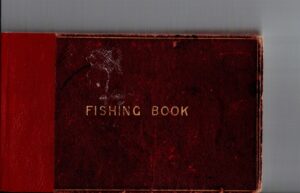
Bevan is said to have fallen from grace in his military career after an affair with the wife of a commanding officer, amongst other shenanigans. In places he is referred to without his military rank, and other times as “Captain H Bevan” (Hey’s 1925, Trout Fishing in South Africa, where he is acknowledged, along with Phillip Barnes as Honorary Fisheries Officers).
Bevan is said to have arrived on the banks of the Bushmans in 1914 and took up residence in a cottage on Snowflake farm, which belonged to Bob Henderson. The building burnt down in 1917, and questions remain as to where that first house was. While it could have been where the Snowflake cottage stands today, a village elder recently pointed out to me with considerable conviction, the site of an earlier abode, where only cut stone fragments remain. But Bill Barnes’ book quotes the original cottage, known as the Angler’s Rest, as being of wattle and daub construction. Either way in 1917, Bevan moved downstream to the spot above the confluence with the Ushiyake, where Henderson’s brother owned the cottage on Eland’s Park farm, which held a commanding view of the river. But before that move, Bevan set about fishing his river as evidenced by the fishing log.
His first entry was on the 26th August 1914. Imagine for a moment, that this was less than a month after the start of world war one. I try to picture Bevan, setting out on that day to fish the “location waters” as they were called, and whether the news of the war had reached him, and how, as a discharged officer that news might have affected him. In the modern context I also ask what he was doing fishing before the start of the season as we know it today. But in 1929 we see that rivers had different seasons, and that the one applied to the upper Bushman’s was from 1 August to 15th April. Indeed, Bavan’s last day of his 1914/15 season on the Bushmans was the 15th of April, so it is possible that these restrictions were in place from the get-go. Later, in the 1936 publication “Fishing the inland waters of Natal” the trout season is displayed as 1 September to 30 April, and Bevan’s 1915 record shows his first day of the season as 15th of September. Also at that time we see a list of apparently well-organised river conservancies including the one for the Bushman’s, presided over by Mr QE Carter of Ennersdale. But in 1914, being a mere 24 years since the brown trout were introduced, we have little idea of the level of regulations, the popularity of the river and the like, save for the fact that the cottage in which Bevan first dwelt was named “Angler’s Rest” and presumably not without reason..
As was the practice in those days, Bevan recorded the total weight and number of his catch, or should I say his “keep”, since small fish returned to the water were of little significance at the time. This means that any attempt to calculate an average fish size is thwarted by the missing details of the returned fish. Suffice to say that the average weight of the fish kept was quite consistently half a pound.
Bevan was inclined to complain about conditions in his log. In the early part of 1915 he consistently noted “too much water” , and in the spring of 1917 he complained “no water” . Wind appeared to get him down too. One entry records “strong wind and no water- most unpleasant morning”.
While the picture alluded to in other writing, is of Bevan fishing the river daily during his 16 years of tenure, in fact there are big gaps, perhaps only in the record of his fishing, one might say, but suffice to note that between September 1917 and September 1925, there is no record at all. A further dent in our portrait of Bevan’s purity as a fly fisherman, is the recording of his use of a “minnow”, complete with the excuse that he was ‘fishing for the pot’ on those occasions, and ‘fish wouldn’t look at a fly’.
We know that Bevan kept company with his friend Barnes at Giants Castle, and the record shows him fishing with Henry Ralfe and one “H Boast”. Aside from that he perhaps kept company with the two pet baboons he is said to have kept for a while. As far as flies go the March Brown Wet was a clear favourite, but there is also mention of the Wickhams Fancy, Teal and Yellow, and Alder fly.
As an aside here, I look to Sydney Hey, who visited in 1927 who wrote of the Bushmans “It is a remarkable river in that it is one of the very few in south Africa where the brown trout have done better than the rainbow”. He goes on to report that the river was stocked with Rainbows in 1918, but that very few were caught after this, and that they soon disappeared.
Mention of Natal Scaly is largely absent but for two entries, one in 1915 when he records a “Scale fish” caught, and then in 1927 when he tellingly writes “ 1 scaly – could have caught more, but no use for them”. In that same season he records the ‘fish of the season- well over two pounds’, but just two years later he nonchalantly records a trout of three and a half pounds as ‘quite a good fish’.
Snippets of Bevan’s life shine through with entries like this one on 10 December 1926: “Had to come back early as I had no cook boy”. And in 1929 “Rode up to Witberg”, but later “Fished upper Elands’s Park – long walk home”, suggesting that his access to a horse may have not always been assured.
The brother of King Langalibalele recently regaled me with his verbally inherited story of how the locals would gather their cattle at a kraal in the deodar trees beside Henderson’s cottage the night before, and then depart at 2:30 the following morning for the long cattle drive to Mooi River to sell the animals, in the days before a cattle truck was an option. Bevan records pool names which are almost impossible to locate now, and one such spot is “Bill’s Kraal”, referring we can assume to Bill Henderson, his landlord. Other indeterminable fishing spots include “Impunze’s” , “Heath’s” and “Green Pool”, the location of which seems lost to history. “Shropaan’s Pool” was however, helpfully included on a map in Bob Crass’ 1971 book, and while colonial spelling was notoriously variable and phonetic, we can pick up mention of the Ushiyake and Ncibidwana tributaries, and make sense of Bevan’s “Home Beat”. But Bevan’s home ceased to be that with his last entry on the 7th of September 1930, and as to his life thereafter, history does not relate.
Excerpt from Bill Barne’s Book, Giants Castle:
Hugh Bevan lived on Snowflake, the farm adjoining the game reserve, which belonged to Mr Bob Henderson. His small cottage, surrounded by a few stately pine trees, was built of wattle and daub, and was very close to the boundary of Location No. I. Its residents, the Hlubis, were always giving trouble with such things as grazing cattle and goats on the neighbouring property, and indeed these incursions would damage Henderson’s crops too. Bob Henderson did not live at Snowflake, but gave Mr Bevan permission to dwell in the cottage in return for its protection and maintenance.
Hugh Bevan was what was known in those days as a “remittance man”, sent out from England by his two sisters to keep him out of the country. He had been in the army, but a taste for women resulted in him being dismissed from the service when an affair with a senior officer’s wife in Ireland was discovered, thus creating the wrath of his two sisters. Life in South Africa began for him in the Orange Free State where he tutored an Afrikaans child for a time. This was not quite to his liking though, so he moved down to Natal. Whilst in Durban for a short while he and a friend got up to mischief at Payne Bros Department Store by filling their drinking water tank outside the store with gin, and then sitting back and watching the fun as people took big swigs thinking it was water and just about choking to death.
He always wore the best of clothes – nothing less than super Saville Row tailored suits would do for this playboy. He had come into two fortunes and lost it all – some £30,000 – gambling at the Monte Carlo casino, yet another reason for his sisters kicking him out of England. He landed in the proverbial by finding Bob Henderson. History does not tell us how they met up with each other.
Bevan was a keen sportsman who loved hunting and fishing, and was an excellent shot with a shotgun when not drunk: it was said that he was a drunkard and spent much of his time looking down the throat of a whisky bottle. So to land a position such as this, with free living, was indeed just what was required, for the partridge shooting was good, especially as he had easy access to the Giant’s Castle Game Reserve when his friend Sydney Barnes was in charge.
The dwelling on Snowflake known as Angler’s Rest was accidentally burnt down in 1917, so he moved across the Bushman’s River to Eland’s Park. Here Bob’s brother had an even better house, and Bevan took up residence for many years. This neat stone cottage was surrounded by sturdy oak trees, most of which still stand today at the time of writing, almost 100 years later. Bevan’s two sisters in England took pity on him, so the story goes, and they sent him out a second-class return ticket to England for him to pay them a visit. Such an insult was not to be tolerated, Hugh remarked. “If they can’t send me a first-class ticket then I will stay where I am”, and promptly tore up the second-class ticket! He obviously preferred the company of his pet baboons to that of his two sisters. These two baboons had been captured when very small. They became great friends, and whenever Bevan went fishing these two would accompany him and play in the water, and jump from stone to stone. On one occasion when Bevan was away they got into his pantry and did untold damage to his meagre supplies. In a fit of rage he shot them both, a deed he was to regret for many years afterwards.
Being a close neighbour of Giant’s Castle he befriended all the staff as they came and went. He became a great friend of Sydney Barnes who, it appears, offered him good partridge shooting on the game reserve. When he was not shooting, the recently introduced brown trout in the Bushman’s River offered excellent fishing to round off his daily life. From time to time Hugh Bevan would act for the forester-conservator when that incumbent was on leave. It was a job that he was only too willing to do, for it even carried a salary of £10 per month. This in turn would mean another bottle or two of whisky.
